Enhancing Option Chain for faster analysis and order execution
Simplified a fragmented options workflow to reduce the time and friction between finding an opportunity and placing an order.

Overview
I led the end-to-end redesign of FYERS’ Option Chain, rethinking how active F&O traders analyse contracts, execute trades and manage positions.
I streamlined the journey from analysis to execution, removing non-critical steps steps and bringing key trading actions closer to the decision point. This increased order placement from option chain by 16% over six months.
Outcomes
For a platform built around core F&O traders, the Option chain is one of its most critical experiences. This revamp helped serve more trading styles and strengthened FYERS' position in advanced trading.
+16%
Orders from Option Chain
~21%
Scalper mode adoption
-28%
Less scroll per active session
Role
Owned the design end-to-end. Led prototyping, user testing, developer handoff and design systems documentation.
Before we dive in
What are options?
Imagine you think NIFTY will rise.
Instead of buying it directly, you pay a small premium for the right to buy it later at today's price. If the market goes up, that premium can multiply into a much bigger profit. If you're wrong, you only lose the premium you paid.
Why the option chain exists?
Once you've decided to trade an option, the next challenge is deciding which one to buy.
For the same stock, there are hundreds of contracts across different strikes and expiries, with prices changing constantly.
Option Chain brings these contracts together in one view, giving traders the information they need to compare opportunities and decide what to trade.

Anatomy of an Option Chain
Context
Options traders need speed and clarity, but traditional option chains often slow them down with scattered information and constant context switching.
Option Chain is where F&O traders compare strikes, analyse market data and identify potential trades.
But the experience didn't end at analysis. Once traders found an opportunity, they had to navigate through multiple interactions before they could actually execute it.
For active traders, this delay matters. Prices move quickly, and additional friction can mean missing the trade.
Traders couldn't analyze the market quickly
Heavy scrolling, limited data visibility and dense color-coding, made it difficult for traders to compare strikes quickly. In a fast-moving market, that often meant missing a good opportunity.
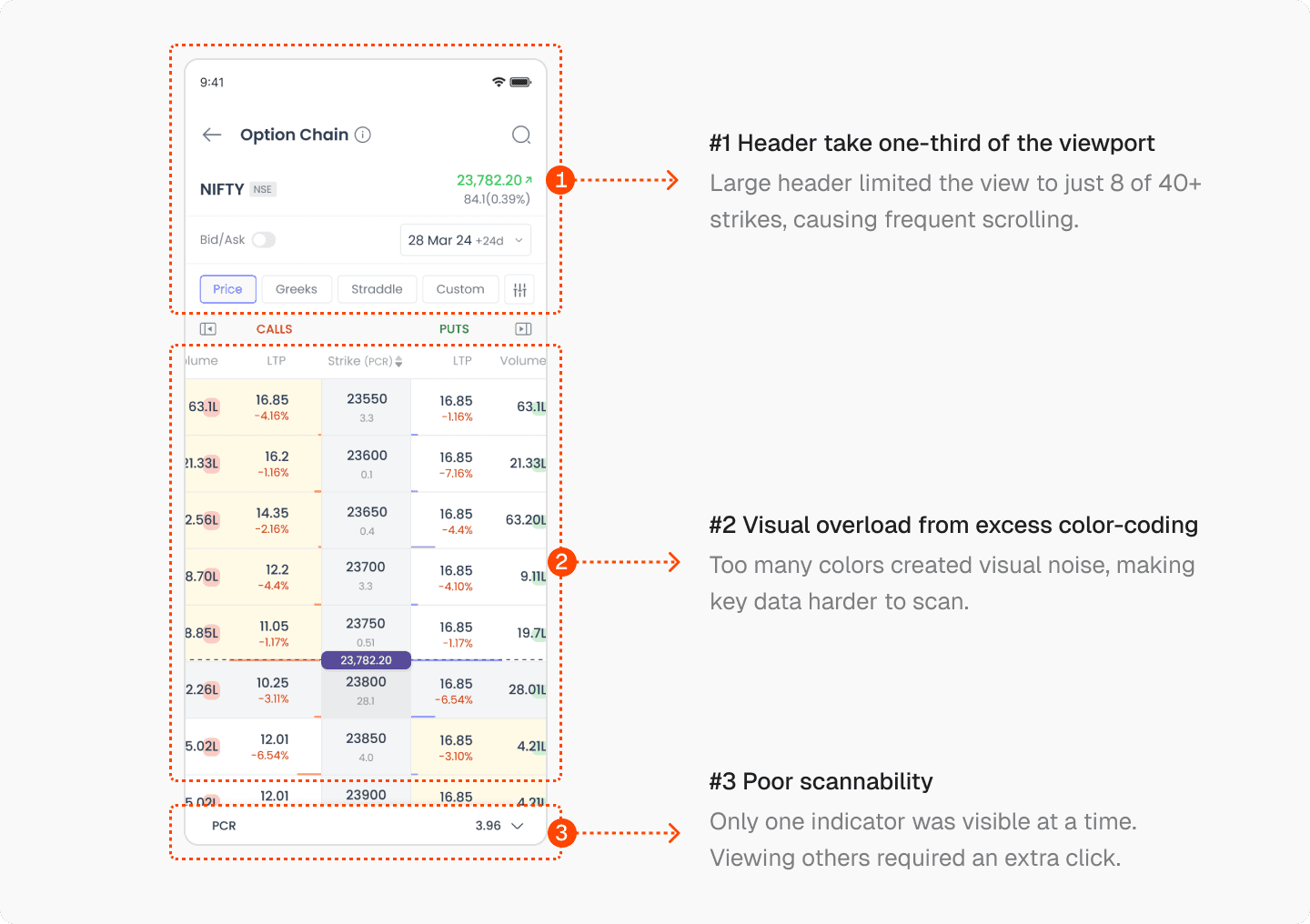
Visual overload
Placing a trade took multiple steps
The Option Chain order flow wasn't built for the speed F&O trading demands. 4+ steps delayed order placement, causing traders to miss ideal entry prices.


~5.8 sec
Multiple steps made the journey slow
Managing positions required switching screens
Once a trade was placed, it didn't appear anywhere on the option chain. Traders had to switch screens to manage positions, making it easy to act on the wrong contract.

Confusion due to lack of position marker
The redesign had to improve the entire trading journey—from analyzing contracts to executing and managing positions.
Process & Iteration
Evolving the Option Chain header
Every iteration challenged what needed to stay visible by default, balancing faster access to critical information with a cleaner, more data-focused interface.
Existing

One-third of the viewport was consumed before any option data appeared.
Version 1

Prioritized live market data by moving the price into the header and dropping the page title.
Removed Search since traders landed on a pre-selected symbol.
Version 2

Moved Bid/Ask into Settings, since most traders didn't use it every session.
Merged four view tabs into one dropdown, trading one extra tap for a full row of visible strikes.
Final
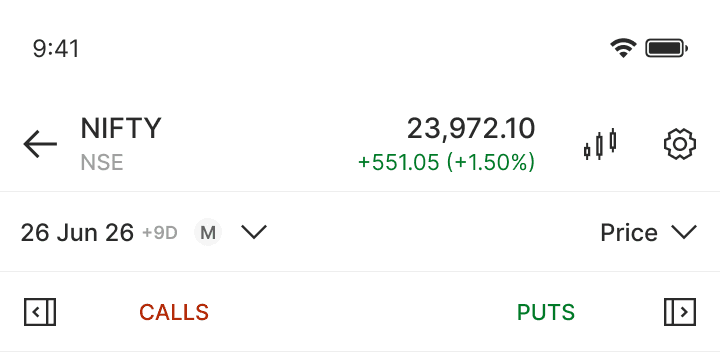
Added a chart shortcut, reducing context switching during active trading.
Optimised dropdowns for compact layout.
Finding a way to show active positions
Each contract in the option chain needed a clear way to show a trader's open position. Here are a few iterations I explored:

❌ Reused the existing Positions icon, but it didn't show position side or quantity.

❌ Explored a colored B/S tag to show side, but it conflicted with the existing P&L colors, making it confusing.

❌ Used +/- quantity to show side, but it widened the strike cell, hid the OI change column, and didn't look tappable.

✅ Used a compact floating chip that preserved the layout while keeping quantity and P&L visible at a glance.

Option chain with positions marker
Solution
👀 Redesigned for faster scanning
The option chain was redesigned around three improvements. The header was reduced from 203px to 126px — a 38% reduction, making room for three additional rows of contracts.
Key indicators moved from a bottom sheet to 0 clicks, and the color palette was simplified from 9 colors to 6 using lower saturation for better readability and industry alignment.

Before → After


⚡️ Introducing scalper mode for faster execution
Scalper Mode moved stop loss, target, and position sizing into a one-time setup, cutting execution to 2 clicks and 2-3 seconds.

Scalper toggle
Kept Scalper inside Settings as a one-time preference, keeping the Option Chain focused and clutter-free.
Preset order preferences
Moved recurring order preferences into Settings, so traders configure them once instead of repeating them for every trade.

~3.0 sec
Reduced order-time decisions
Pre-configured order settings, leaving quantity as the only decision during execution.
Kept traders in the Option Chain
Displayed positions and order confirmations inline, removing unnecessary screen switches.
Outcomes
For a platform built around core F&O traders, the Option chain is one of its most critical experiences. This revamp helped serve more trading styles and strengthened FYERS' position in advanced trading.
+16%
Orders from Option Chain
~21%
Scalper mode adoption
-28%
Less scroll per active session
